Author: tully97

Crossword #002

| Across |
| 4. Issue with joke online (5) |
| 6. Find in favour of remedy (7) |
| 8. Female regularly fixing price of hearing aid (8) |
| 9. Drained cartons-full of boozy half ouzo, half malt punches (6) |
| 10. In parsonage, minister houses brothers (6) |
| 11. Dense loaf not made with grain (8) |
| 12. Marine bands playing loud type of drum (6) |
| 13. No time during stay for outbound daytrips (6) |
| 16. I die pure, moving to rest during prayer (8) |
| 18. Stream flowing from peak (6) |
| 20. Vegan pizza topping apparently entertaining butter substitute (6) |
| 21. Hose designed to let water flow through (8) |
| 22.Biennial festival of tailless horse and cattle (7) |
| 23. Spirited mule stuck in walls of sty (5) |
| Down |
| 1. Shock as monetary constraint in Order restricts rise of Knight (8) |
| 2. Rebels against Tory strongholds introducing cut to teacher entitlement (14) |
| 3. Indulge comedian’s skill (6) |
| 4. Cheer up; end of life isn’t here yet (5) |
| 5. Patrician ideas affected junior doctors (14) |
| 6. Short, exact summary (6) |
| 7. Offers on retro fashion (Gaultier’s closing clearance) (7) |
| 12. A lot of wealth (7) |
| 14. Collapsing on stairs might pose a fire hazard (8) |
| 15. Expose vixen’s trick (6) |
| 17. Where to take a soldier for breakfast (6) |
| 19. Introduction to English sporting success (5) |
The post that launched a thousand puzzles
As this is ostensibly a blog about words, it makes a certain sense to begin it with what many see as the foundational text of European literature. The Iliad has been the inspiration for countless novels, poems, video games, films, and now at least one crossword. For me, though, it will also always be associated with beginnings.
There’s its place in the first crossword on this website, of course, but I will always remember my first term at University, sat in the back of lectures about Achilles and friends. My laptop perched before me, I would flick between one tab of frantic note-taking and a second of a crossword dredged from some corner of the internet. A new beginning, the Iliad, and crosswords all bound together, which gets us three quarters of the way to this blog.
You see, crosswords have always been a social pasttime for me. My mother and her mother taught me how to do cryptics and my other grandmother would save the Telegraph’s massive, two-page general knowledge crossword to do together the next time I visited. Even those clandestine grids at the back of a lecture hall were social – my now-girlfriend and I offering silent solutions to each other, taking the tradition of passing notes between classmates to its most academic conclusion.
It likely makes sense, then, that I think crosswords can – and should – be shared. The smile that’s raised by a particularly witty clue is all the sweeter when you can tell (or boast to) someone else about it. The two tricky blanks in a pesky bottom left are a bit more solvable with a second brain on hand.
And so, after making the switch from solving clues to writing them – largely because I needed something vaguely academic to do after final exams finished – I wanted to share them. So here we are: the last quarter falls into place.
To say I have a plan of exactly what this site will look like is quite an overstatement. I have ideas, though, mainly that there will likely be three forms of post appearing on here.
Firstly, we have the obvious. Every week, a cryptic crossword will materialise – as if from the ether – to be downloaded for your enjoyment. I personally have a preference for quality surfaces so the difficulty of these puzzles will vary day-to-day and clue-to-clue. Ultimately, I want a clue to be fun, and to share that fun with you.
Secondly, there’ll be a post like this (although normally less autobiographical and rambling – at least that’s the hope). If a week’s crossword has a theme, the accompanying blog will likely have a bit of a sojourn into why it does and what it means. In general, though, I’d like to focus on what it’s like cluing certain words. The crossword blogs I really love tend to focus on the other end of the equation – breaking down how a clue works. While this is a great part of the internet, I’ve found that one of the things that helps me most in approaching a crossword is working out how the setter approaches it. Maybe it will help someone else if rather than just parsing the crossword they’ve just done, there’s some discourse as to why it exists in the first place. Or maybe this is all just an excuse I’ve made up to let me self-indulge and write about crosswords. In any case, crossword one day, blog a few days later.
Finally, to make sure there’s something every day, even when there’s no full crossword, I’ll take a topical word of some kind – a dictionary’s word of the day or something in the news – and clue that. A quick bite of a standalone ‘Clue for the Day.’
Anyway, as this is supposed to be the second type of post, I should practice what I preach. Spoilers for Crossword #001 now abound.
Some would argue that proper nouns – and particularly personal names – have no place in cryptic crosswords. In most instances I would agree, and yet two people crop up in this first crossword; the first of many hypocrisies I’m sure you’ll find herein.
There are too many reasons to list as to why names are lacking in crosswords. Prime among these is the issue of spelling – the Iliad version I read at University had the (rather haughty) options of Achilleus and Hektor for the two men who crop up in this crossword. My spellcheck is telling me that, while these are accurate transliterations of the Greek, they are not recognised spellings. For a further example, we need look no further than the first introduction we get to Leo McGarry in the West Wing:
“Margaret, please call the editor of the New York Times crossword and tell him that Khaddafi is spelled with an H and two D’s and isn’t a seven-letter word for anything.”
Leo’s wrong, by the way, or at least not completely right. Nor is it ‘right’ to spell Hector with a ‘c’ or a ‘k.’ They’re merely interpretations of the best way of transliterating names into the Latin alphabet. Spelling names is a minefield; it’s safer to stick to what’s in the dictionary.
But despite this – and of course the traditional rules of Scrabble et al that forbid proper nouns– setters do indulge the odd desire to throw a name or two around in their puzzles. This presents a weighty challenge, one faced by philosophers throughout the years. How do you define a person?
Too much specificity in the clue’s definition would likely read terribly and make a clue too easy. Seeing a clue that ended with ‘second woman to be PM’ and a (3) after it may verge on the guessable. The inverse, though, is just unfair. While “woman cooked yam” is a terrible clue for many reasons, if I’m trying to clue May, defining her as one of literally over half of humanity is a bit too broad. What’s to stop the solution being ‘Amy?’
So where’s the middle ground?
As far as I’ve seen, there are two main ways of approaching the conundrum. The first, and simplest, is the ‘professional’ method. As in crossword #001, you pick a job – or at a stretch another characteristic – that truly defines that person. I would argue (as I suppose I have to) that Achilles and Hector are heroes in the truest sense, no doubt helped by the fact that the modern word can trace its meaning back to them. Where with a normal word you find a synonym given as the surface definition, here you find an umbrella group.
Naturally, the size of that umbrella has to nestle neatly between the overly specific and the hopelessly broad. This can be helped by the use of the referential clue. I actually have no idea if there’s a name for this kind of clue – one where part of the clue references the answer to another – and so let’s stick with ‘referential clue’ to describe it.
If the umbrella group you’ve found is obvious or clunky – meaning that it would be inelegant to have it in numerous clues – it can be disguised as another answer. One great example of this that sticks in my mind was an Imogen crossword in the Guardian from a few years ago. About a quarter of all the clues linked back to one mammoth, centre-piece solution; dead white European male.
To have written that out as the definition for all the sub-clues would have first of all looked ridiculous, but more importantly removed both a lot of the difficulty and a lot of the fun. Instead, the crossword was given a theme, all the solutions had appropriate definitions, and the challenge and enjoyment of the crossword was maintained. The umbrella group approach won through.
The first time I tried to clue Achilles, Hector, and Trojan War for this puzzle, I had linked them, with the clues for the first two including a ‘participants in Trojan War’ approach. In fact, the only reason I didn’t was because of the double meaning of ‘Harry’ that can be brought into the Hector clue. It is worth remembering that my rules for cluing here are not universal; setters will write what sounds best.
That said, the second school of dealing with the proper noun comes at it from the opposite direction; specificity. I have always been a fan of the cryptic definition – I grew up on Rufus’ Monday Guardian puzzles – and a sub section of this type of clue is the use of a witty charade as the definition within a clue rather than as the clue in its entirety. In the first instance, we would find a clue such as 29a in #001. It is, in essence, a pun pointing us towards the only answer it could be: a scorer counts runs and to score is to scratch. London’s Evening Standard is normally a good source for this type of clue.
Such specificity can be embedded in a wider clue. Staying with the theme of prime ministers, while ‘Elder Statesman? (4)’ might suffice as a clue for ‘Pitt’ in and of itself, to complicate it a bit, we can incorporate it into a clue such as:
Elder statesman engrossed in pulpit talk (4)
It makes the clue less elegant, maybe, but it allows for a more interesting surface and helps avoid the clunky juxtaposition of words that can define the double or cryptic definition genre.
So there you have it. If you want to clue (or understand how a setter might clue) a proper noun every now and then, I hope this has given you some ideas. Disguise the definition, dress it up as a pun, or sneak it in as part of some wider group – the cruciverbalist’s Trojan Horse.
Crossword #001
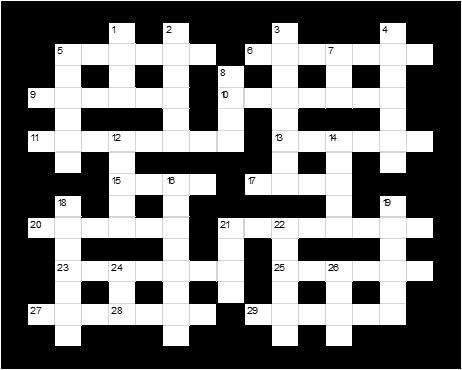
Across:
5. City pinnacle is unfinished (6)
6. Jump cut (7)
9. Struggle for rickety taxi to get round motorway (6)
10. A polis showing beginnings of demagogue-inspired bitterness (7)
11. Final step in making a good tart (8)
13. Storyteller assumes points can be arranged from A to B (6)
15. Soviet Russia endlessly reconstructed (4)
17. As I am incontinent (4)
20. Fisherman wrangles naked at sea (6)
21. Sends out doctor lost to waves (8)
23. Almost perfect, though lacking order (7)
25. New Testament’s not showing support for beliefs (6)
27. Soldier starts to retreat, rashly inciting others trapped in conflict (7)
29. Does he count the runs from scratch? (6)
Down:
1. Deceiver blags middle part of speech (4)
2. Stew that is cooked for dog (6)
3. Waves wash over calm hero (8)
4. Maybe Christmas today? Holly’s arranged but much left out (4,3)
5,24. Worker counted among Jarrow march in decade-long struggle (6,3)
7. A German’s kind of package holiday? (3)
8. Postman calling (4)
12. Having the same quality (5)
14. Gets close to springing trap (5)
16. Very sour construction inspector (8)
18. Removes outer layer of tree after uncle gets cut (7)
21. Broken statue (4)
22. Spot for books in French city (6)
24. See 5d
26. AM CONFUSED AS USUAL!!?? (4)
 Never a Crossword